
Across the 2024 – 2025 school year, Texas schools using STEMscopes Math for 4th grade outperformed comparable schools on state math outcomes. This study builds on last year’s findings, showing positive results again with a new group of students.

To understand the impact of STEMscopes Math, we compared STAAR math outcomes in schools using STEMscopes with those from schools using other math programs. We wanted to make sure that the schools we compared were similar in many ways, so any differences in scores would be due to STEMscopes Math. We matched schools based on several characteristics. First, we separated schools by large Texas regions (South, Houston area, East/Central, Dallas/East of Dallas area, Northwest), and then we matched schools based on the percentage of students from different ethnic/racial backgrounds, the overall size of the school, school rating, and the percentage of students receiving special services.
1. Overall Performance: Students in schools using STEMscopes Math in 4th grade had significantly higher STAAR benchmarks than comparison schools in all positive categories (Approaches, Meets, Masters), and a significantly lower percentage of students who did not meet grade level benchmarks. STAAR scale scores in STEMscopes schools were 4.00+ points higher than non-STEMscopes schools. This means STEMscopes schools gained more across the 4th grade year: STEMscopes schools gained ~103 points on average between 3rd and 4th grade, while control schools gained ~99 points.
2. STAAR Math Category Performance: The STAAR Math test includes four categories of mathematical knowledge: Numerical Representations, Computations and Algebraic Relations, Geometry and Measurement, as well as Data Analysis and Personal Finance. STEMscopes Math was associated with statistically positive effects for Numerical Representations and Relationships, Computations and Algebraic Relationships, as well as Data Analysis and Personal Finance Literacy. The strongest effect was for the Computations and Algebraic relationships, a category that is foundational for later Algebra achievement, with STEMscopes schools scoring over a percentage point higher on average in this category than non-STEMscopes Schools.
3. Regional effects: When we examined results across five large Texas regions, STEMscopes schools showed positive outcomes in every region on both STAAR scale scores and the percentage of students reaching key performance benchmarks. Results were strongest in South Texas and the Dallas/East of Dallas area, where the differences between STEMscopes and comparison schools were most pronounced. Some regions showed clearer statistical differences than others, which can happen when regions differ in the number of participating schools and local context.
4. Subgroup Analyses: All student subgroups in STEMscopes Math schools had positive increases in the percent of students meeting grade level benchmarks and above compared to non-STEMscopes Math schools. Significant differences were observed for several key student groups, including females, Hispanic/Latinx students, English Language Learners, and Gifted and Talented students. Impacts were similar across subgroups.
Figure 1 Note: all findings were significant, p < .05
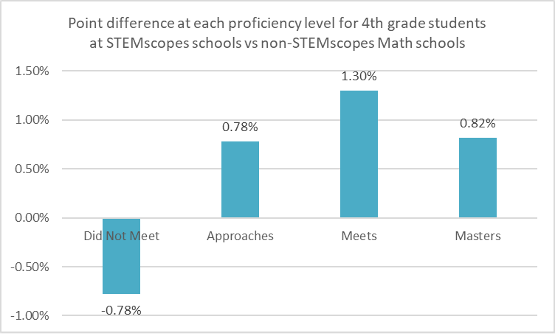
Figure 2 Note: all differences were significant, p < .05
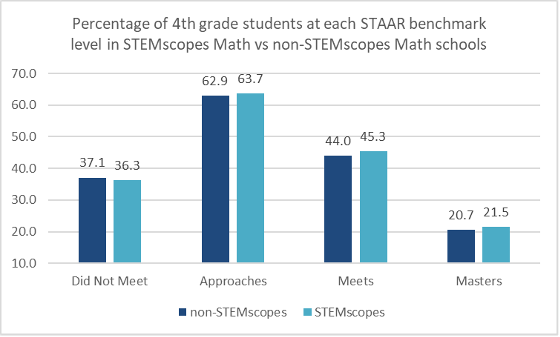
This report provides evidence that STEMscopes Math is consistently associated with improved math achievement for student groups in Texas’ elementaries. The current results demonstrate a reliable finding relative to the previous cohort last year that are in line with “moderate evidence of effectiveness” (Tier 2) based on ESSA (Every Student Succeeds Act) guidelines.

Designed to make measurable impacts on student achievement, Accelerate Learning Inc. offers you a customized STEM solution for all your students. Learn how you can preview or demo our products for free.

Explore More Research & Case Studies


